
The percentage needs an operating point
A welder can claim 60% duty cycle at one amperage and a different percentage at another. At lower current, less heat is generated and the machine may weld for a larger share of the ten-minute cycle. At maximum output, the arc-on window may be much shorter.
Write the rating as 'X% at Y amps at Z volts.' If a listing omits the amperage or voltage, the percentage cannot be compared honestly with another machine. A 60% badge may sound better than 30% until you see that the first machine is at 100A and the second at 215A.
Turn the percentage into minutes
The usual ten-minute duty-cycle window makes the arithmetic straightforward. Multiply ten minutes by the percentage. 30% gives three minutes of arc and seven minutes of cooling; 60% gives six minutes of welding and four minutes of cooling. The arc-on time is not the total time you spend at the bench because fitting, clamping and inspection interrupt the arc.
Do not use the duty-cycle percentage as a stopwatch for every bead. Use it to understand whether the machine has enough thermal reserve for the work. If the thermal protection trips repeatedly at normal settings, the machine may be undersized for the job or the cooling conditions may be poor.
Voltage and environment shift the result
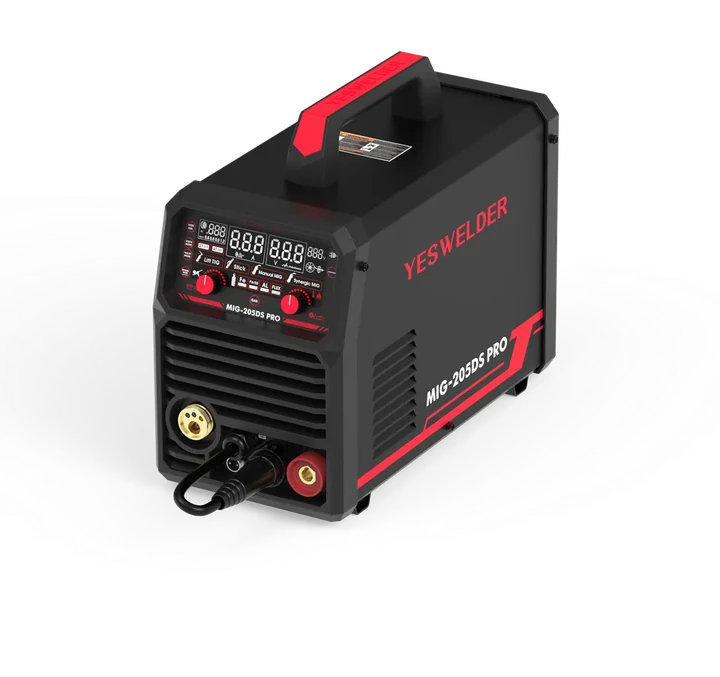
YesWelder's MIG-205DS Pro page publishes 60% at 160A for MIG on 110V and 60% at 205A on 220V. The same headline percentage describes different output points depending on the supply. Compare the entire row, not the percent in isolation.
Ambient temperature, ventilation, fan condition and process also affect how long the machine can run before thermal protection. A dirty cooling path or a hot garage can reduce real-world performance. The manufacturer's rating describes a controlled test condition; your work environment may be less forgiving.
Use duty cycle to match the project
A cart with short tacks and repositioning may fit a machine whose arc-on time is short. A long frame seam, production repair or repeated bead is a different thermal job. The machine with enough duty cycle for your process will keep working instead of forcing frequent pauses.
If the duty-cycle rating at your working current is missing, ask the seller or download the manual. Do not infer it from the maximum amperage. A documentation gap is a reason to slow down, not a reason to invent a number.